
Short answer
Professional exterior paint prep includes inspecting the house, washing off dirt and mildew, scraping and sanding loose paint, repairing rotted wood, priming bare wood, caulking open seams and masking everything not being painted. Each step removes something that stops paint from bonding. Homes built before 1978 also require lead-safe work by a licensed firm.
Key takeaways
- Most peeling traces back to moisture or skipped prep, not to bad paint.
- Mildew has to be killed before painting or it grows through the new coat.
- Bare wood starts losing its ability to hold paint after short sun exposure. Prime it promptly.
- Joints that will be painted need a paintable siliconized acrylic caulk. 100 percent silicone cannot be painted.
- In Oregon, painting that disturbs more than 20 square feet of exterior paint on a pre-1978 home requires a contractor with a CCB Lead-Based Paint Renovation (LBPR) license.
Why does exterior paint peel?
Usually because of moisture or a surface that was not ready. A Purdue Extension publication co-written with the USDA Forest Products Laboratory links paint problems to water from rain and dew getting into porous or thin paint coats, and notes that if an old paint surface is not properly cleaned before repainting, the new coat can peel away from the old one. Prep is the part of a paint job that prevents both.
What happens before the finish coats go on?
| Step | What it involves | What it prevents |
|---|---|---|
| 1. Inspect | Check siding, trim and moisture; note failing paint and soft wood | Surprises mid-job and painting over damage |
| 2. Wash | Remove dirt, chalky old paint and mildew; rinse and let dry | Poor adhesion and mildew growing through new paint |
| 3. Scrape | Remove all loose and lifting paint | New paint lifting off with the old |
| 4. Sand | Feather the edges of scraped areas; sand weathered wood | Visible ridges and weak bonding to gray wood |
| 5. Repair | Replace rotted boards and trim; fix leaks and flashing | Paint failure from moisture behind the siding |
| 6. Prime | Prime bare wood, repairs and stain-prone wood | Peeling and tannin bleed-through |
| 7. Caulk | Seal open seams at windows, doors and trim | Water getting behind the siding |
| 8. Mask | Cover windows, fixtures, roofs, decks and plants | Overspray and cleanup damage |
| 9. Finish | Apply the finish coats | Thin, uneven color and early wear |
Why does a painter inspect the house first?
A good painter walks the whole house before quoting. That means checking for soft or rotted wood (usually at trim, fascia, window sills and the bottom courses of siding), failing caulk, peeling patterns and moisture. Peeling concentrated in one area often points to a moisture source such as a leak, bad flashing or a bathroom vent, and BuildingGreen notes that those problems need to be fixed first or they will cause bigger failures later.
Why does the house get washed before painting?
Paint cannot bond to dirt, pollen or chalky old paint, so the house gets washed first. The Purdue and Forest Products Laboratory guide recommends scrubbing chalked surfaces with a detergent solution to remove old deposits.
Mildew is common on shaded Oregon walls and it needs special handling. It has to be killed before repainting, not just rinsed, or it will grow through the new paint. After washing, the siding needs time to dry fully before any primer or paint goes on.
Why does loose paint have to be scraped and sanded?
Any paint that is lifting, cracking or flaking comes off. Paint applied over loose paint lifts with it. After scraping, the edges are sanded (feathered) so the transition between bare wood and sound paint lies flat and does not show through the finish. The Journal of Light Construction describes scraping, feathering and sanding as the standard for wood siding.
If the house was built before 1978, scraping and sanding can release lead dust. That work has to follow the lead-safe rules below.
Can you paint over rotted wood?
Paint does not fix rotted wood. It hides it for a season. Soft wood is cut out and replaced before painting, and new boards should be primed on the back and ends before they are installed so they do not soak up water from behind. Any leak or flashing problem that caused the rot gets fixed at the same time.
When does bare wood need primer?
Bare wood should be primed soon after it is exposed. In tests at the USDA Forest Products Laboratory, primer bonded best to wood with no sun exposure, and the bond weakened the longer the bare wood sat in sunlight before priming. Sam Williams of the Forest Products Laboratory concluded that smooth-planed lumber must be painted promptly. Wood that has already turned gray should be sanded back to fresh wood before priming. Research published in the Journal of Coatings Technology found short periods of weathering decrease paint adhesion and service life, and that sanding was the most effective fix.
Cedar and redwood contain natural extractives that can bleed through paint as brown stains. For those woods, the Purdue and Forest Products Laboratory guide recommends an oil-based stain-resistant primer or a latex primer specifically formulated for staining woods.
Why does caulking matter on an exterior paint job?
Gaps around windows, doors, corner boards and trim let water get behind the siding. Joints that will be painted need a paintable caulk. Fine Homebuilding reports that siliconized acrylic-latex caulk has better adhesion and makes longer-lasting joints than plain acrylic-latex. Pure silicone caulk cannot be painted, so it does not belong on joints that are getting a finish coat.
What gets covered and protected?
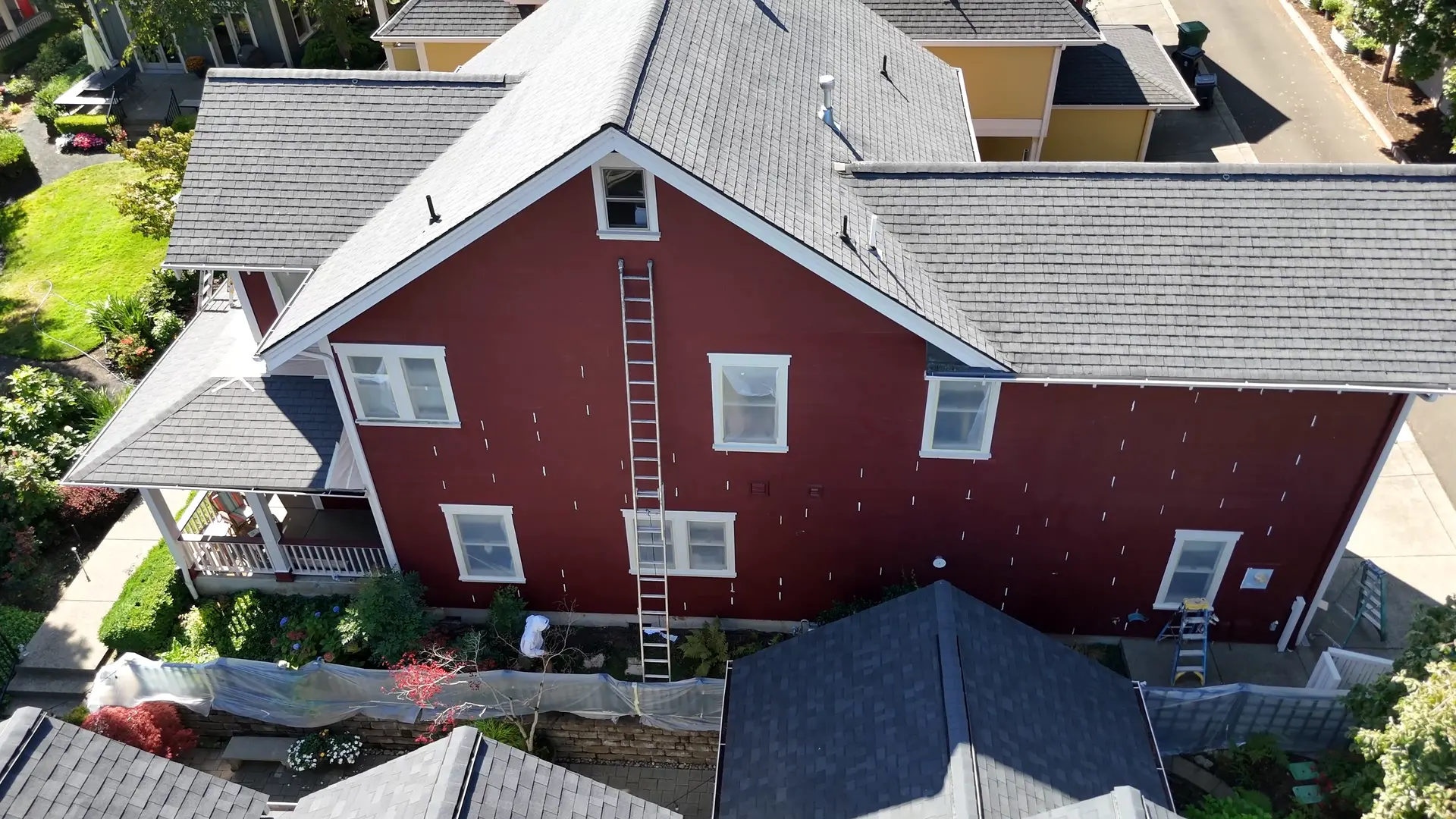
Windows, light fixtures, hardware, roofs, decks, walkways and plants are covered before anything is sprayed or rolled. Clean lines and a clean property both come from careful masking.
How many finish coats does an exterior need?
With the surface clean, sound, dry, primed and sealed, the finish coats go on. At QC we apply two full finish coats on exterior work so the color is even and the paint film is thick enough to hold up through wet Oregon winters. Weather still matters at this step: the surface must be dry, within the label's temperature range and more than 5°F above the dew point.
What should an exterior painting estimate include?
Because prep decides how long a paint job lasts, it should be spelled out in the estimate, not left to assumption. When you compare bids, look for these in writing:
- How the house will be washed, and how mildew will be treated
- How much scraping and sanding is included, and how bare wood will be primed
- Whether rotted wood repair is included or priced separately once found
- Which caulk and primer will be used, and where
- The paint product and the number of finish coats
- For homes built before 1978: the firm's CCB Lead-Based Paint Renovation license and lead-safe work practices
What are the lead-safe rules for painting an older home in Oregon?
Homes built before 1978 may have lead-based paint, and scraping or sanding it creates hazardous dust. Under the EPA's Renovation, Repair and Painting (RRP) rule, work that disturbs more than 6 square feet of painted surface per room inside, or more than 20 square feet outside, must be done by a certified firm using lead-safe practices. Window replacement is covered regardless of size.
In Oregon, a CCB-licensed contractor doing this work needs a Lead-Based Paint Renovation (LBPR) license from the Construction Contractors Board, and at least one person in the business must complete accredited RRP training. You can check a contractor's CCB license and LBPR endorsement on the CCB's license search.
Frequently asked questions
What is the most important step in exterior paint prep?
Getting the surface clean, sound and dry. Paint fails when it is applied over dirt, mildew, loose paint, rotted wood or damp siding, so washing, scraping, repairs and drying time matter more than the paint itself.
Do you need to prime before painting a house exterior?
Bare wood, new boards, repairs and stain-prone woods like cedar should always be primed. Sound, previously painted surfaces in good condition usually only need spot-priming where bare wood shows.
Can you paint over mildew?
No. Mildew has to be killed and washed off first, or it will grow through the new paint.
How long should siding dry after washing before painting?
It depends on the weather and the wood, so the reliable answer is a moisture meter reading. Guidance from the USDA Forest Products Laboratory is never to paint wood above about 20 percent moisture content.
Does a painter need a lead license for a pre-1978 house in Oregon?
Yes, if the work disturbs more than 20 square feet of exterior paint or 6 square feet per room inside. Oregon requires a Construction Contractors Board Lead-Based Paint Renovation (LBPR) license for CCB-licensed contractors doing that work.
Sources
- Cassens, D.L. (Purdue University) and Feist, W.C. (USDA Forest Products Laboratory), Discoloration of House Paint: Causes and Cures, NCR-134
- Green Building Advisor, Whether Wood Weathers (on USDA Forest Products Laboratory primer adhesion tests)
- Journal of Coatings Technology (American Coatings Association), Restoration of Severely Weathered Wood
- Fine Homebuilding, What's the Difference: Paintable Caulk
- BuildingGreen, Scraping the Surface of Exterior Paint Prep
- Journal of Light Construction, Paint Over Stain?
- InspectAPedia, Exterior Paint & Stain Guide (citing USDA Forest Products Laboratory research)
- U.S. EPA, Renovation, Repair and Painting Program: Contractors
- Oregon Health Authority, RRP Rule for Contractors and Painters
- Oregon Health Authority, Frequently Asked Questions: Contractors and Painters
- Oregon Construction Contractors Board, Specialty Licenses & Certifications