
Short answer
There is no single number that fits every house. How long an exterior paint job lasts depends on the product, the prep, the siding, and which walls take the weather. USDA Forest Products Laboratory tests rank a primer-and-paint system as the longest-lasting film finish on wood siding. In the mid-valley, wet winters, a short dry summer, and walls that stay damp in the shade all shorten that life when the surface was not ready.
Key takeaways
- Forest Products Laboratory exposure tests found that paint systems outlasted solid-color stains, which outlasted semitransparent stains and clear finishes.
- South- and west-facing walls take more sun. North walls and sheltered sides stay damp longer after rain and are more prone to mildew.
- Most early failures trace back to moisture or skipped prep, not to a can of paint that 'didn't last.'
- Chalking, fading, cracked caulk, peeling and bare wood are the usual signs it is time for a new job.
- The sides of a house rarely wear at the same rate, so a good estimate inspects every elevation, not just the street view.
Why isn't there a single lifespan for exterior paint?
Because the climate, the siding and the workmanship change the result more than the calendar does. A Forest Products Laboratory study by Williams and Feist followed 35 finishes on western redcedar siding for 14 years at two outdoor sites. Service life rose in a clear order: clear water-repellent preservatives, then lightly pigmented preservatives, then semitransparent stains, then solid-color stains, then paints. The same study found that saw-textured siding held almost every finish longer than smooth-planed siding. Those tests were not run in Oregon, but they show why two houses painted the same year can need work at very different times.
Manufacturer warranties also are not a lifespan. They describe coverage under stated conditions. What you get on a house in Woodburn, Keizer or Silverton depends on whether the wood was dry, whether bare spots were primed, and how much rain, shade and sun each wall sees.
What wears paint out in the Willamette Valley?
Moisture first, then sun. Salem averages about 40 inches of rain a year, with most of it falling from November through March (NOAA 1991-2020 normals). Water that gets behind a thin or cracked film, or into unpainted end grain and open joints, is the classic cause of blistering and peeling. A Purdue Extension guide co-written with the Forest Products Laboratory traces paint discoloration and early failure to rain and dew moving through porous or thin coats, and to new paint applied over a dirty or unsound old coat.
| Factor | What it does | Where it shows up |
|---|---|---|
| Rain and trapped moisture | Blisters, peels, and soft or rotted wood | Lower siding, north walls, joints, end grain |
| Shade that stays damp | Mildew and a film that stays wet after storms | North sides, under trees, behind shrubs |
| Sun | Fading, chalking and a film that gets brittle | South- and west-facing walls |
| Skipped prep | New paint lets go of the old coat, or of bare wood | Any elevation that was not washed, scraped or primed |
| Failed caulk | Water enters at seams and around trim | Windows, corners, siding laps, fascia |
Do all sides of the house wear at the same rate?
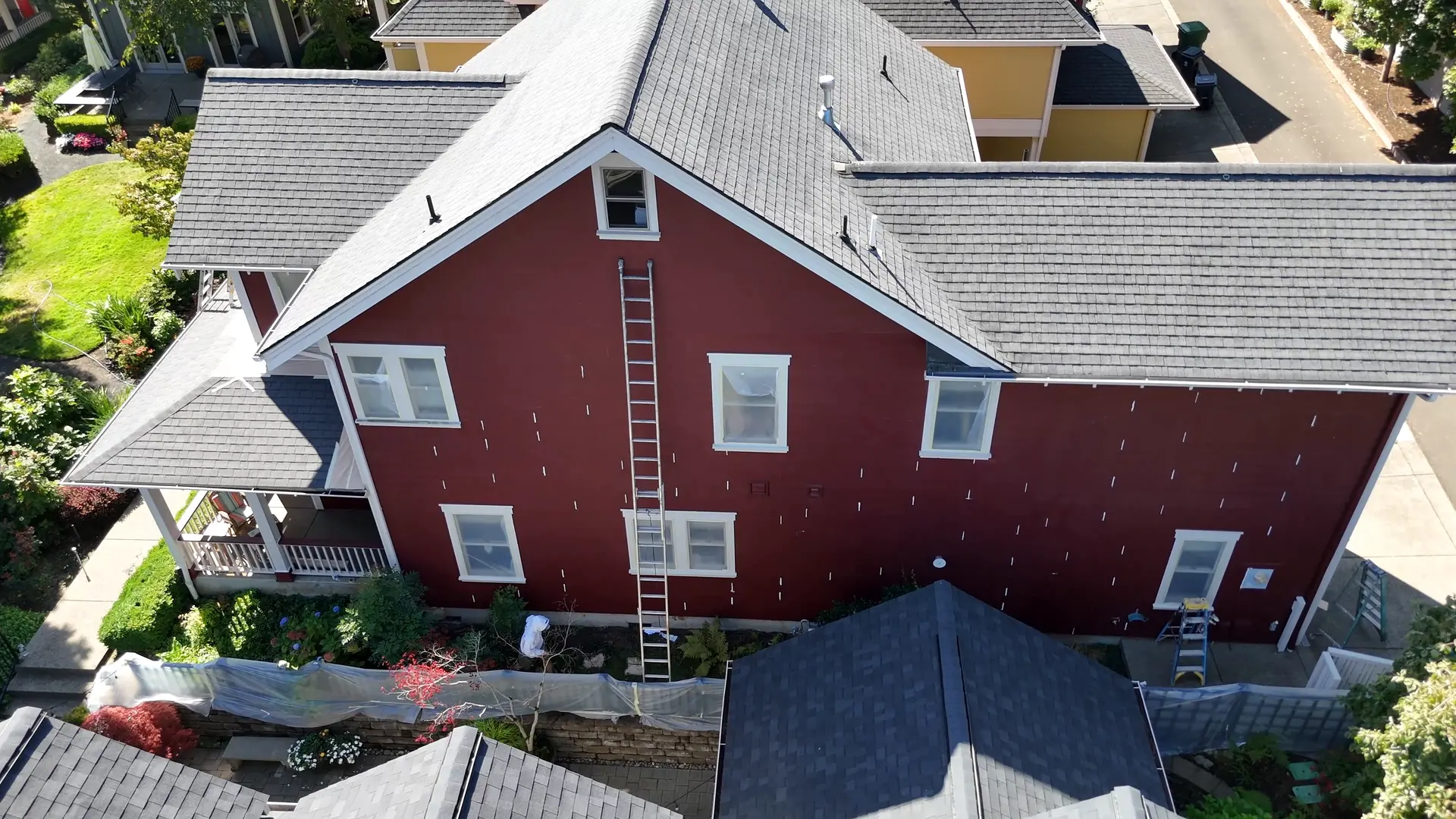
Almost never. South- and west-facing walls take the most sun, so color fades and the film chalks sooner there. North walls and sides tucked under trees dry slowly after Oregon rain. Those elevations are where mildew and peeling from trapped moisture show up first. A house can look fine from the street and still need work on the back or the shaded side. That is why an estimate should walk every elevation, including the areas you do not see from the driveway.
How can you tell it is time to repaint?
Look at the film, the caulk and the wood, not just the color. Common signs: chalk that comes off on a hand, fading that no longer matches a protected spot under an eave, hairline cracking, caulk that has pulled away from joints, peeling or blistering, mildew that returns after a cleaning, and bare wood. Once paint has failed down to wood, the next job is a repair and prep job, not a simple recoat. It is easier, and it lasts longer, to repaint while the old coat is still sound.
What should an estimate include if you want the job to last?
The same items that decide how long the last job lasted. Ask to see, in writing, how the house will be washed and how mildew will be treated, how much scraping and priming is included, whether rotted wood is part of the bid or listed separately, which primer and caulk will be used, and how many finish coats are included. Homes built before 1978 also need a contractor with a CCB Lead-Based Paint Renovation license when the work disturbs enough old paint. A bid that skips those steps is often the reason a paint job fails early.
Frequently asked questions
Does exterior paint last as long in Oregon as it does in a drier climate?
Usually not, if moisture gets into the siding or the film. The Willamette Valley's wet winters and shaded walls that stay damp are harder on paint than a dry climate. Good prep, dry wood and a full paint system close that gap.
Which side of the house needs paint first?
Often the south or west side if the problem is fading and chalking, or the north and shaded sides if the problem is mildew or peeling from moisture. An inspection of every elevation is the only reliable answer.
Can you just paint the sides that look worn?
Sometimes, if the rest of the film is still sound and the color can be matched. Many houses need a full repaint once caulk, bare wood or widespread chalking show up in more than one place. A painter can tell you which case you are in after looking at the house.
Does the type of siding change how long paint lasts?
Yes. Forest Products Laboratory work found that saw-textured wood held finishes longer than smooth-planed wood. Fiber-cement, metal and vinyl each have their own product limits, including rules about how dark a color can be on vinyl.
Is peeling always a sign the paint was poor quality?
No. Peeling usually means moisture got behind the film, or the surface was not clean, dry and sound when it was painted. The product is only part of it. Prep and moisture control decide whether the job lasts.
Sources
- Williams, R.S. and Feist, W.C. (USDA Forest Products Laboratory), Service life of finishes on smooth-planed and saw-textured western redcedar bevel siding, JCT Coatings Tech, 2007
- NOAA National Centers for Environmental Information, U.S. Climate Normals 1991–2020, Salem McNary Field (USW00024232)
- Cassens, D.L. (Purdue University) and Feist, W.C. (USDA Forest Products Laboratory), Discoloration of House Paint: Causes and Cures, NCR-134
- InspectAPedia, Exterior Paint & Stain Guide (citing USDA Forest Products Laboratory research)
- Sherwin-Williams, Vinyl Siding Warp (painting vinyl siding)